
My own experience of school meals began in the 1970’s, first at infants and then at “big school”, otherwise known as juniors. You could smell something cooking all morning as the smell wafted through the assembly hall / come PE room / come dining hall. Unfortunately what appeared when the hatch was lifted rarely lived up to what your imagination had conjured up all morning.
Throughout the year the menu consisted of liver and onions, corned beef pie, spam fritters and sausage plait, as well as a varying number of stews. I say menu, but that implies there was a choice. As I remember it, there was lunch. You ate it, or you went home. I don’t even remember anyone having a packed lunch.
Much of it was dished up courtesy of an ice cream scoop, served from aluminium boxes, very familiar to what still exist in some kitchens today. However, pudding could rescue any unpleasantness from the main meal that you had pushed around your plate. Chocolate concrete, semolina, pink custard, tapioca or “frogspawn” as we generously called it, with a dollop of jam. Whatever negotiations had taken place with the dinner ladies on wanting to leave your main meal tried, but rarely finished, there was always enthusiasm for dessert.
Looking back, those meals were trying to provide nourishment on a very tight budget. Whether we appreciated their nutritional value at age 7 is another matter.
From eating them to providing them
I left primary school in 1979. The following year, the Education Act 1980 changed the framework for school meals in England and Wales. It removed the requirement on local education authorities to provide meals, while retaining provision for eligible children receiving free meals. National nutritional standards and fixed pricing also went. Decisions about the service were left to individual authorities.
I first ventured into school catering myself in South Wales in 1996, that’s 30 years ago!! I’m still coming to terms with that calculation.
The perspective from inside the service was rather different from the one I held as a pupil.
Back then, we worked to the “Caroline Walker Trust” guidelines, with school lunch intended to provide around one third of a child’s daily nutritional intake. The assumption being that the other two thirds would be provided at home.
At college, baking was never my strong point. It required precise measurements, which didn’t sit comfortably with my preferred method of “a bit of this and a bit of that”. But the school cooks taught me enough dependable pudding recipes that even I began to think I could bake. They deserve most of the credit.
The kitchens never seemed to have any heating, so turning the cooking equipment on first thing had the welcome side effect of warming the cooks as well as the kitchen. Central heating was clearly an unnecessary luxury.
There were still dieticians and special diets, special dietary requirements. The cooking equipment was older, but had been very well maintained. The biggest issue was if the knob fell off the oven, you had to buy a whole new one as the manufacturer had gone out of business at least 20 years prior.
There were no dishwashers, it was a sterilising sink (double sink method). These have all but disappeared now.
Many cooks had joined when their own children were young because the hours fitted family life. Years later, they were still there, with considerable skill, experience and knowledge of their schools.
The food in the schools where I worked was good. There was a commitment to feeding children properly. That deserves remembering whenever school meals history is reduced to a procession of turkey dinosaurs.
School meals return to the spotlight
Since then, school meals have repeatedly returned to public attention.
Compulsory nutritional standards for school lunches were reintroduced in England and Wales in 2001. Jamie Oliver’s campaigning later helped put school food firmly into the national conversation. Wales developed its own approach through Appetite for Life and the Healthy Eating in Schools regulations, which came into force in 2013.
During the pandemic, Marcus Rashford helped bring attention to children’s access to food during school holidays. Government-funded holiday programmes now operate in both England and Wales, alongside other community provision.
But with each renewed wave of attention comes a familiar question: does the funding match what we are being asked to deliver?
What does the money buy?
Take England’s universal infant free school meal funding. In 2015–16, the rate was £2.30 per meal. For 2026–27, it is £2.66, an increase of just under 16%.
Over roughly the same period, the statutory adult minimum hourly rate rose from £6.50 in early 2015 to £12.71 from April 2026. That is an increase of approximately 96%. It does not measure every catering employee’s pay, but it illustrates the pressure on a service that depends on people’s time.
Wales has a different funding arrangement. All primary children in maintained schools can now access a free school meal, and the universal primary scheme’s funding rate has increased to £3.40 per meal. The English and Welsh figures should not be treated as a single UK rate.
Behind every plate are ingredients, wages, energy, cleaning, equipment and maintenance.
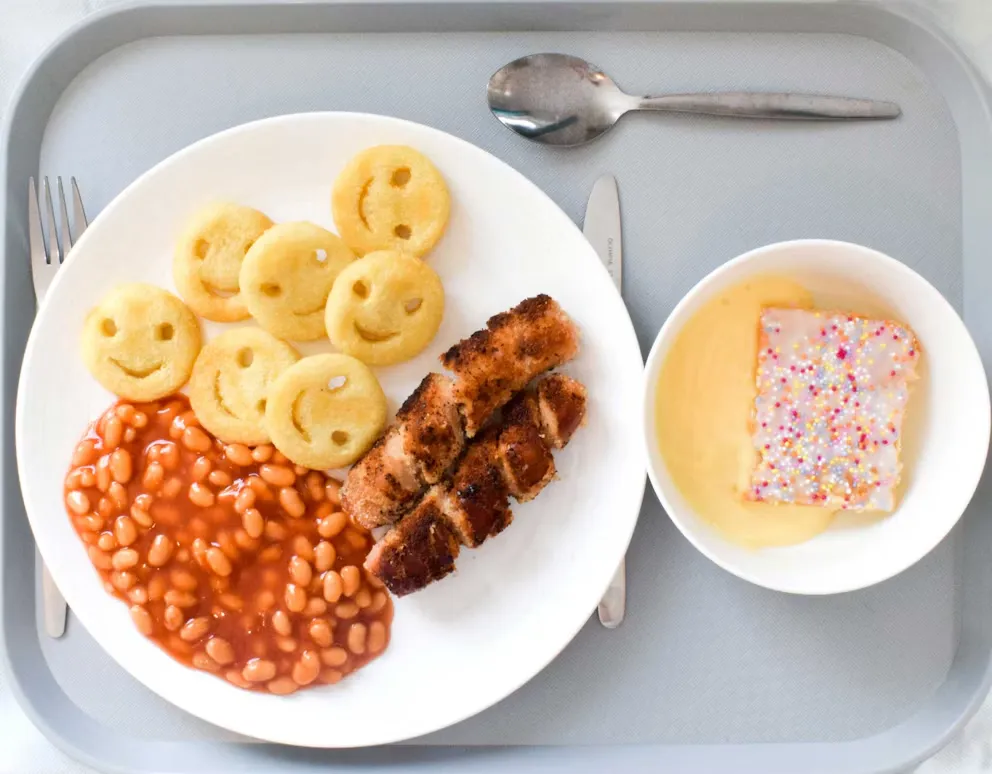
Why not simply make cheaper meals?
An obvious question is why kitchens cannot return to cheaper ingredients and traditional dishes.
I suspect a relaunch of braised liver or pigs’ trotters would require rather more than an enthusiastic assembly.
An inexpensive ingredient is only the beginning of the calculation. Preparation time, cooking costs, available equipment and waste all affect the final cost.
A cheap meal that children will not eat is an expensive way to fill a food-waste bin.
There are sensible ways to adapt. Replacing some meat in a familiar cottage pie, curry or Bolognese with lentils or beans can help a budget stretch while adding fibre. But producing an affordable, balanced meal is one task. Persuading children to eat it is another.
As parents and catering professionals, we broadly understand what a balanced meal should look like. Helping children enjoy unfamiliar ingredients, flavours and textures takes patience, skill and repeated opportunities to try them.
Who is checking?
Standards also need meaningful oversight.
In Wales, local authorities and governing bodies have responsibilities for compliance, including when meals are supplied by a contractor. Guidance identifies practical checks such as reviewing menus, requesting evidence and visiting to see whether the food served matches what was promised.
For school leaders, the useful question is how those checks work in their own school.
Does the advertised menu reflect lunch on the day? Are children eating it? What comes back on the trays? Does the catering team have the staffing, equipment and support to deliver consistently?
A compliant menu is an essential starting point. Understanding the lunchtime experience requires spending time in the dining room and the kitchen.
Are you seeing the pattern yet?
Across my experience of school meals, there is a recurring “mousewheel” pattern.
Renewed attention, higher expectations and difficult decisions about how to pay for them.
Political enthusiasm can help bring change. It needs to be matched by a realistic understanding of delivery.
When that gap remains, responsibility travels down the line. School leaders must balance budgets. Caterers must meet standards. Kitchen teams must produce meals that children will eat.
When the result disappoints, the food on the plate is easy to scrutinise. The financial decisions behind it are less visible.
School leaders have every reason to ask for nutritious food, reliable service and evidence that children are benefiting. They should also be able to ask whether the resources match those expectations.
After 30 years, I have seen what skilled school catering teams can achieve. I have also seen how much effort goes into making a limited budget work.
They deserve policies built around that reality.
Before the next school meals promise makes the headlines, perhaps we should just ask three simple questions:
What will it cost, who will fund it, and how will we know it is working?